

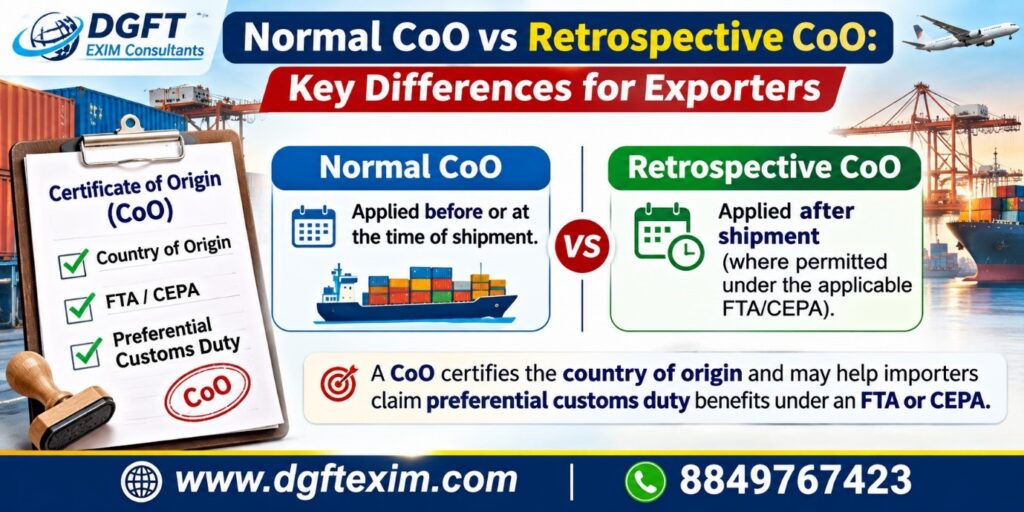
A Certificate of Origin (CoO) is an important export document that certifies the country of origin of goods. It is commonly required by importers and customs authorities and may help importers claim preferential customs duty benefits under an FTA or CEPA, subject to applicable rules.
Exporters should understand the difference between a Normal CoO and a Retrospective CoO to avoid documentation issues.
What Is a Normal CoO?
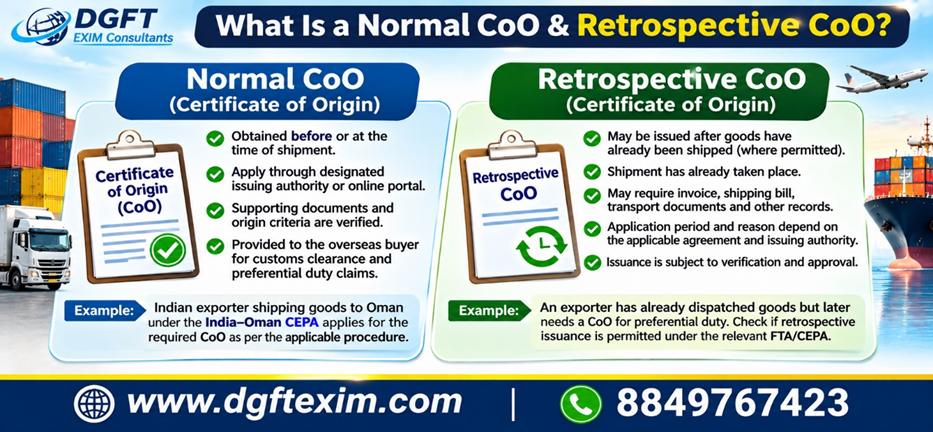
A Normal Certificate of Origin (CoO) is generally obtained before or at the time of shipment, following the applicable agreement and issuing authority’s procedures.
Key points:
- The exporter applies through the designated issuing authority or online platform.
- Supporting documents and origin criteria must be verified.
- The certificate is provided to the overseas buyer or importer for customs clearance and, where applicable, preferential duty claims.
Example: An Indian exporter shipping goods to Oman under the India–Oman CEPA applies for the required CoO according to the applicable procedure.
What Is a Retrospective CoO?
A Retrospective Certificate of Origin may be issued after goods have already been shipped, where the applicable FTA or CEPA rules permit it.
It may be relevant when an exporter did not obtain the certificate before shipment or needs to apply after dispatch.
Key points:
- The shipment has already taken place.
- The exporter may need to submit the invoice, shipping bill, transport documents and other supporting records.
- The reason for applying after shipment and the permitted application period depend on the applicable agreement and issuing authority.
- Issuance is subject to verification and approval under the relevant rules.
Example: An Indian exporter has already dispatched goods to a foreign buyer but later discovers that a CoO is required to support a preferential customs duty claim. The exporter should check whether retrospective issuance is permitted under the relevant trade agreement.
Difference Between Normal CoO and Retrospective CoO
| Particulars | Normal CoO | Retrospective CoO |
| Application timing | Generally, before or at shipment | After shipment, where permitted |
| Shipment status | Planned or underway | Goods already dispatched |
| Documentation | Origin and shipment-related documents | Origin, shipment documents and any additional evidence required |
| Eligibility | Subject to applicable rules | Subject to specific retrospective issuance provisions |
| Duty benefit | Subject to origin rules and agreement conditions | Subject to the same applicable origin requirements and import-side conditions |
Important Points for Exporters
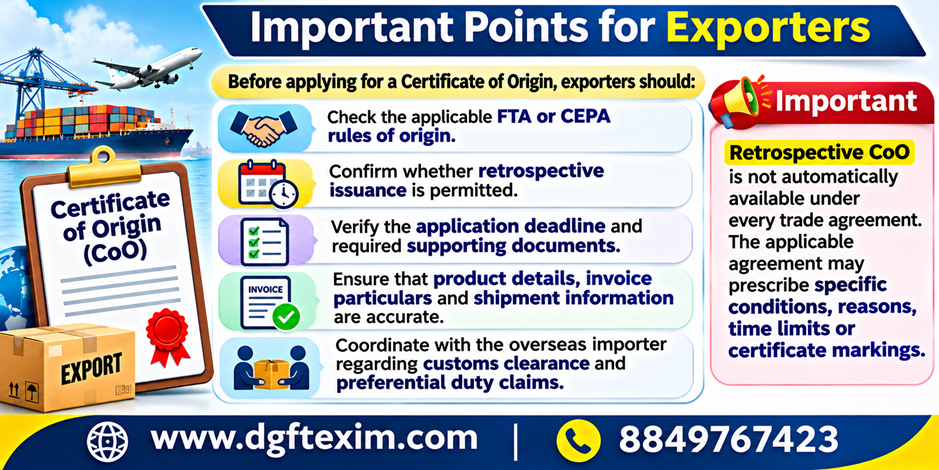
Before applying for a Certificate of Origin (CoO), exporters should follow these important steps:
- Check the applicable FTA or CEPA rules of origin.
- Confirm whether the relevant trade agreement allows retrospective CoO issuance.
- Check the application deadline and prepare all required supporting documents.
- Verify product details, invoice particulars, and shipment information for accuracy.
- Coordinate with the overseas importer to support customs clearance and preferential duty claims.
Important: Exporters cannot obtain a retrospective CoO automatically under every trade agreement. Each agreement may specify particular conditions, acceptable reasons, time limits, and certificate markings. Therefore, exporters should check the applicable FTA/CEPA rules and confirm the requirements with the issuing authority before applying.greement may prescribe specific conditions, reasons, time limits or certificate markings.
Conclusion
Both Normal CoO and Retrospective CoO help exporters complete their export documentation. However, the main difference lies in the timing of issuance. Exporters should check the applicable FTA or CEPA rules and consult the issuing authority before applying, especially if they have already shipped the goods.
For assistance with Certificate of Origin, FTA, CEPA, and export-import documentation, contact DGFT EXIM Consultants.