

Introduction
The Advance License, also known as the Advance Authorisation Scheme, helps Indian exporters reduce production costs and improve global competitiveness. Under this scheme, businesses can import raw materials, packaging materials, and essential components without paying customs duty. They must use these imported goods to manufacture products that they export to international markets.
For exporters, the Advance Authorisation system is highly beneficial because it helps reduce manufacturing expenses and improves competitiveness in global markets. Businesses applying for an Advance Licence for Export can significantly lower operational costs while expanding their international trade opportunities.
To receive approval under this scheme, applicants must prepare accurate documentation and follow the guidelines issued by DGFT carefully.
Importance of Advance Authorisation
The Advance Authorisation Scheme plays an important role in India’s export industry. Import duties often increase the total production cost for exporters. By using an Advance License, companies can import necessary materials without additional duty charges.
This scheme helps businesses:
- Reduce import expenses
- Improve profit margins
- Increase export competitiveness
- Manage working capital more effectively
- Expand international business operations
Industries such as textiles, engineering goods, pharmaceuticals, chemicals, food processing, and electronics commonly use the Advance Authorisation facility.
Many businesses also prefer professional Import Export Consultancy Services to handle the application process smoothly and avoid documentation mistakes.
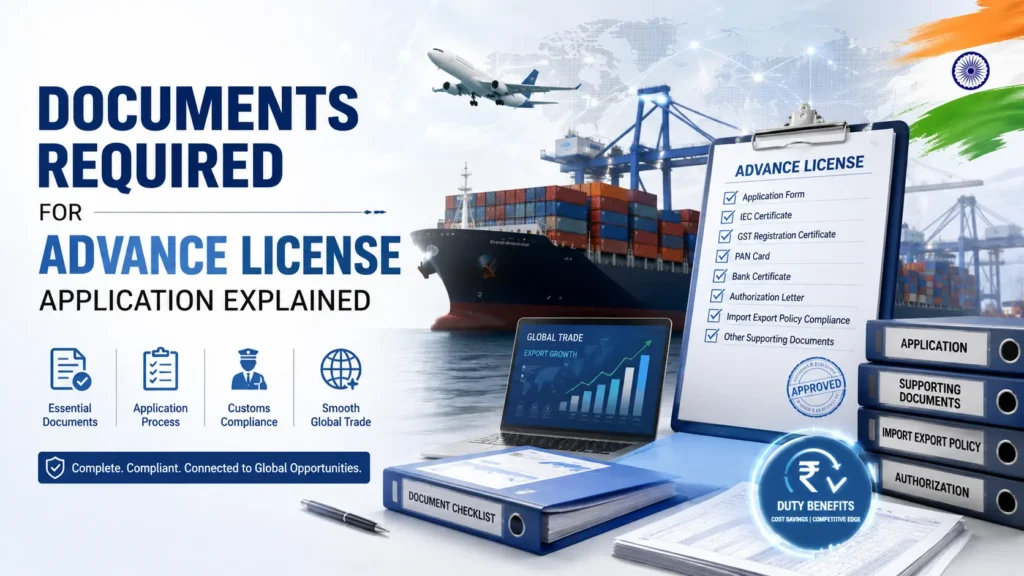
Documents Required for Advance License Application
Businesses applying under the Advance Authorisation Scheme generally need the following documents:
1. Import Export Code (IEC)
The IEC issued by DGFT is mandatory for every exporter and importer in India.
2. GST Registration Certificate
This document verifies the legal tax registration status of the business.
3. PAN Card
The company’s PAN card is required for financial and identity verification.
4. Business Registration Documents
Applicants must submit documents based on their business type, such as:
- Certificate of Incorporation
- Partnership Deed
- LLP Agreement
- Proprietorship Registration Proof
5. Export Order or Purchase Order
A confirmed export order from an overseas buyer is required to prove that imported materials will be used for export production.
6. Bill of Materials (BOM)
The BOM explains the quantity and type of raw materials needed for manufacturing export products.
7. Manufacturing Process Details
Basic production and manufacturing details may be required during the approval process.
8. Bank Certificate or Cancelled Cheque
These documents are submitted for verification of bank account information.
9. Previous Export Documents
Export invoices, shipping bills, and Bank Realization Certificates may be required for businesses with export history.
10. Digital Signature Certificate (DSC)
Since applications are filed online, a DSC is necessary for secure submission and authentication.
Benefits of Advance Authorisation
There are several advantages of using the Advance Authorisation Scheme for export businesses.
Duty-Free Imports
Businesses can import raw materials without paying customs duty.
Lower Production Costs
Reduced import expenses help improve overall profitability.
Better International Pricing
Exporters can offer competitive pricing in overseas markets.
Improved Cash Flow
Companies can save working capital by avoiding upfront duty payments.
Simplified Online Process
The DGFT portal has made the application process more convenient and transparent.
Because of these benefits, many exporters rely on experienced Import Export Consultancy Services for professional guidance and faster processing.
Where is Advance Authorisation Used?
The Advance License facility is widely used in industries such as:
- Textile manufacturing
- Pharmaceutical exports
- Food processing
- Chemical manufacturing
- Engineering goods
- Electronics production
Any business manufacturing export goods using imported raw materials can apply for an Advance Licence for Export.
New exporters often search online for Import Export Agents Near Me to find expert consultants who can help with DGFT documentation, compliance, and approvals.
Cost of Advance Authorisation Consultation in Delhi
The pricing for Advance Authorisation Consultation in Delhi may vary depending on:
- Nature of the business
- Number of products covered
- Complexity of documentation
- Export volume
- Compliance requirements
Basic consultancy services may include document preparation and online filing, while complete assistance packages may include end-to-end DGFT support, follow-up services, and export compliance management.
Hiring reliable Import Export Consultancy Services in Delhi can help businesses save time, reduce errors, and improve approval success rates.
Conclusion
The Advance License or Advance Authorisation Scheme is an effective solution for exporters looking to reduce import costs and improve global business opportunities. However, correct documentation and proper compliance are essential for successful approval.
Understanding the application process, required documents, and benefits of Advance Authorisation can help exporters take full advantage of this government scheme. Businesses can also simplify the process by working with professional Import Export Consultancy Services or experienced Import Export Agents Near Me for expert assistance and guidance.