
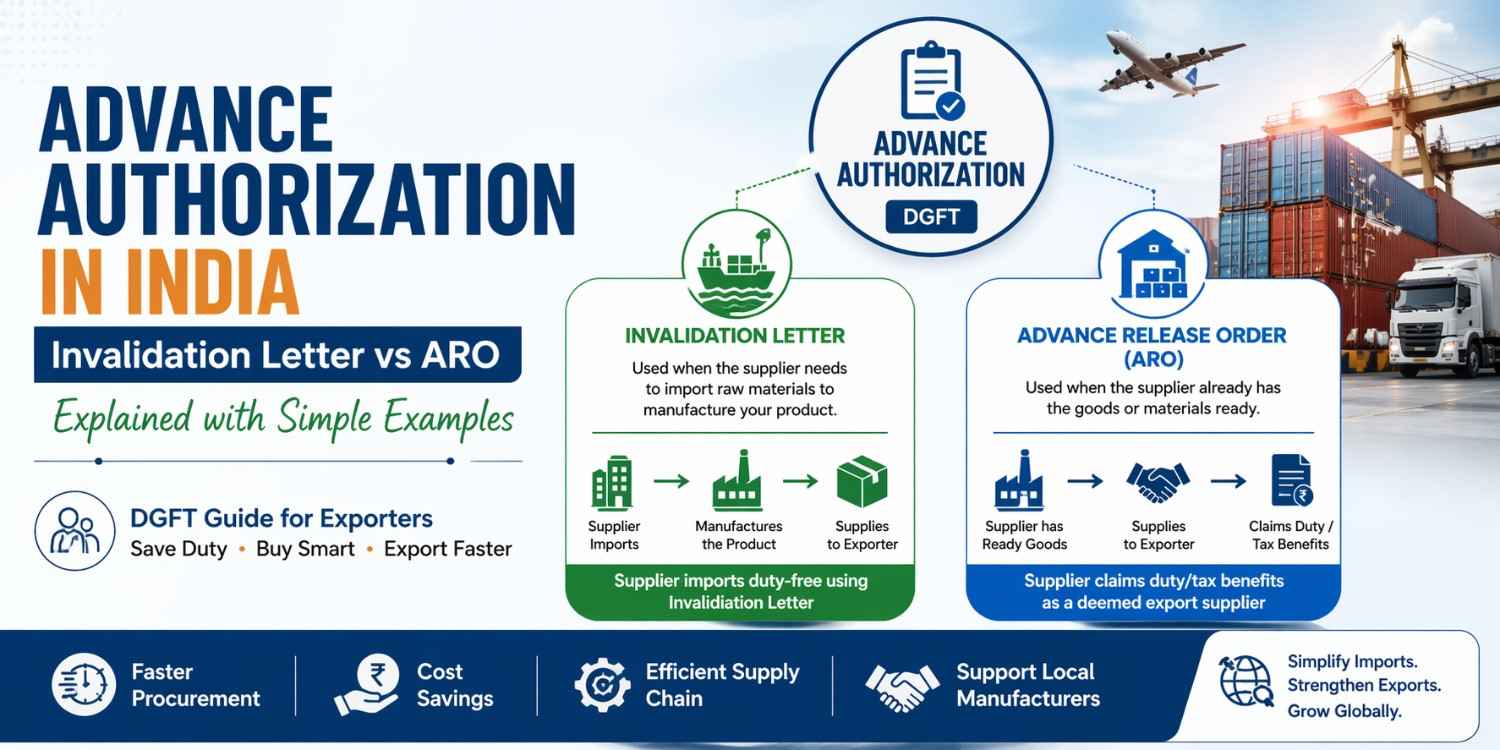
Advance Authorization in India: Invalidation Letter vs ARO Explained with Simple Examples
If you are an exporter in India, you may already be using the Advance Authorization (AA) scheme. This scheme allows you to import raw materials without paying customs duty, as long as you use those materials to make export products.
But here is something many exporters do not know:
You do not always need to import.
You can also buy from Indian suppliers and still get the same benefit.
For this, the government provides two options under the Directorate General of Foreign Trade system:
- Invalidation Letter
- Advance Release Order (ARO)
This blog explains both in very simple language with examples.
What is Advance Authorization?

Advance Authorization is an export incentive scheme that allows an exporter to import inputs duty-free for manufacturing export products. The purpose of the scheme is to reduce the cost of production and make Indian exports more competitive in global markets.
Normally, the exporter imports the required raw material directly. However, in many situations, buying locally is faster, simpler, and more practical. The DGFT system allows this flexibility through Invalidation Letters and AROs.
You can also buy from Indian suppliers and still get the same benefit.
For this, the government provides two options under the Directorate General of Foreign Trade system:
- Invalidation Letter
- Advance Release Order (ARO)

What is an Invalidation Letter?

An Invalidation Letter is used when the Indian supplier needs to import raw materials in order to make the product that you require. In this case, you do not use your own import authorization directly. Instead, you allow your supplier to use the duty-free benefit attached to your Advance Authorization.
Think of this as: "I’m giving my tax-free 'coupon' to my Indian supplier."
You use an Invalidation Letter when your Indian supplier needs to import their own materials to make the product for you. By "invalidating" your right to import, you pass that duty-free benefit to them.
Example of Invalidation Letter

Suppose you are an exporter of office chairs and you have an Advance Authorization for specialized fabric. You find a supplier in Surat who can make that fabric for you, but they need to import premium yarn from abroad to produce it.
In this situation, you can request an Invalidation Letter. Your supplier can then use that letter to import the yarn duty-free, manufacture the fabric, and supply it to you.
This is useful when the local supplier does not already have all the required inputs and must import something to complete your order.
What is Advance Release Order (ARO)?

An Advance Release Order (ARO) is used when you, as an exporter, want to buy goods from an Indian supplier instead of importing, while still using the benefit of your Advance Authorization issued by the Directorate General of Foreign Trade.
Think of this as: "I’m buying locally, and the supplier wants a tax refund."
An ARO is used when the Indian supplier already has the goods or materials ready. They don’t need to import anything new; they just want to be rewarded for selling to an exporter (which is called a "Deemed Export").
Two Practical Scenarios in ARO

Scenario 1: Supplier uses imported raw materials
The supplier manufactures your product using imported inputs
Since duties were paid on those imports, the supplier can claim:
Custom duty benefit/refund (as per applicable provisions like drawback or exemption)
Tax benefits (GST-related benefits under deemed export)
Simple Example:
A manufacturer imports special plastic granules, pays duty, and makes export packaging for you.
Under ARO, they can later claim back eligible duty/tax benefits.
Scenario 2: Supplier uses only local raw materials
The supplier manufactures the product using only Indian raw materials
In this case:
No customs duty benefit (because nothing was imported)
Supplier can claim only tax-related benefits (GST deemed export refund/exemption)
Simple Example:

Suppose you are an exporter of jewellery and you need packaging boxes for your export consignment. You find a box manufacturer in Ahmedabad who already has 5,000 boxes ready in stock.
In this case, you can ask for an ARO. You buy the boxes locally, and your supplier uses locally sourced paper to make cartons for your exports. Under ARO, they can claim GST-related benefits.
Difference Between Invalidation Letter and ARO

The easiest way to understand the difference is to ask one question to the supplier:
Do you need to import raw materials to make my order, or do you already have the goods ready?
If the supplier wants to import duty free raw materials, then an Invalidation Letter is generally used.
If the supplier wants the benefit of refund of duties & tax paid on raw material Imported/Domestic as a deemed export supplier, then an ARO is generally used.
So, the basic rule is simple: Invalidation Letter is for supplier import support. ARO is for ready local supply and tax benefit. uses the ARO to claim the refund or duty benefit as permitted under the scheme.
Why Exporters Use These Options
Both options help exporters save time, reduce logistics issues, and improve business efficiency.
First, local procurement is faster than waiting for international shipments. This can reduce production delays and help exporters meet tight deadlines.
Second, buying locally often reduces freight, insurance, and port-related costs. This can improve overall margins.
Third, local sourcing supports Indian manufacturers while still keeping the exporter eligible for duty benefits.
Finally, these options simplify supply chain management because the exporter can work with domestic suppliers instead of handling every import directly.
Need help with your DGFT Paperwork? Applying for the wrong document can lead to tax complications. At DGFT EXIM Team, we help exporters navigate these rules smoothly so you can focus on your production.
- Call/WhatsApp: +91 88497 67423
- Website: dgftexim.com