

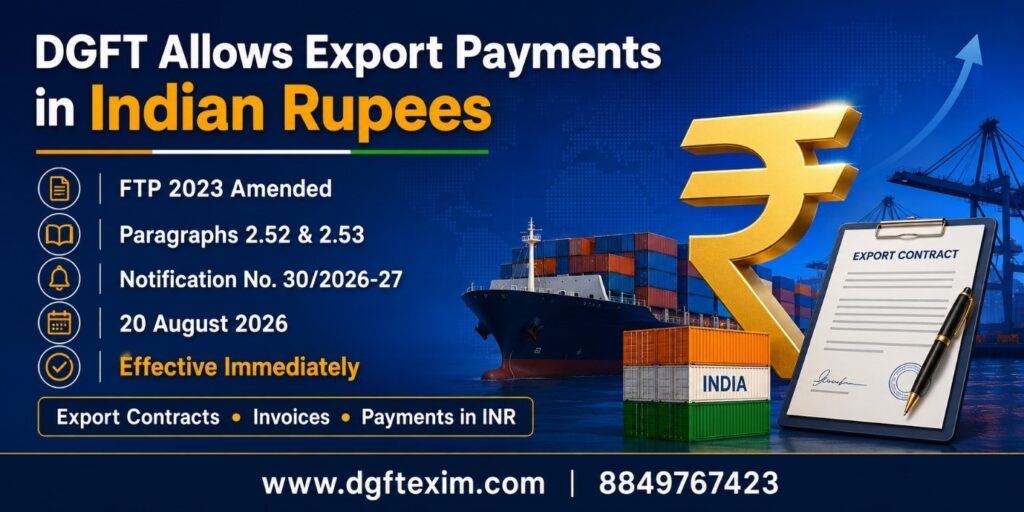
The Directorate General of Foreign Trade (DGFT) has amended Paragraphs 2.52 and 2.53 of the Foreign Trade Policy 2023 through Notification No. 30/2026-27 dated 20 August 2026.
The amendment, effective immediately, provides greater flexibility for export contracts, invoices and payments in Indian Rupees.
· What Has Changed?
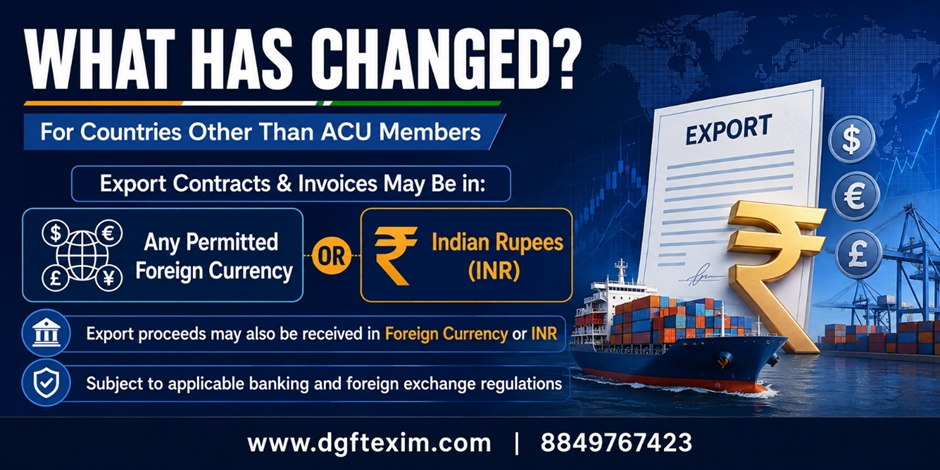
For exports to countries other than Asian Clearing Union (ACU) member countries, export contracts and invoices may be denominated in:
- Any permitted foreign currency, or
- Indian Rupees (INR)
Export proceeds may also be received in foreign currency or INR, subject to applicable banking and foreign exchange regulations.
· Will INR Payments Qualify for Export Benefits?
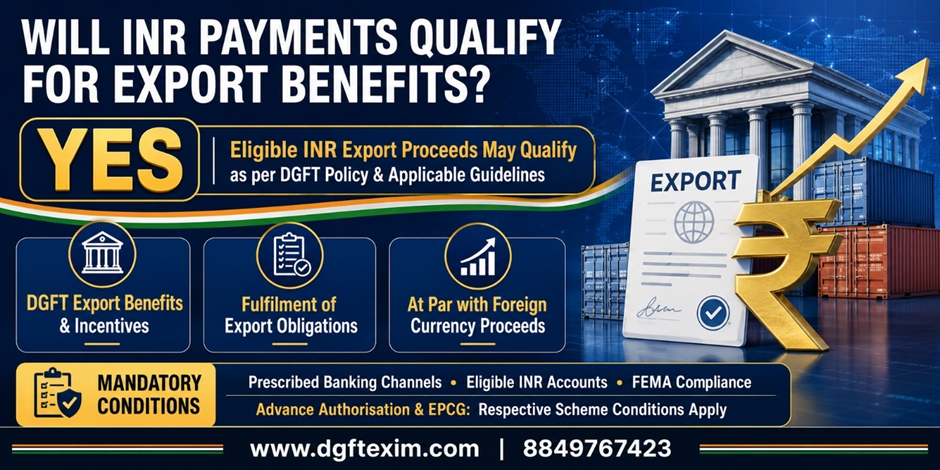
Eligible export proceeds received in Indian Rupees may qualify for:
- DGFT export benefits and incentives
- Fulfilment of Export Obligations
- Treatment at par with proceeds received in foreign currency
The payment must be received through prescribed banking channels involving eligible INR accounts of persons residing outside India, in accordance with applicable FEMA regulations.
Eligibility under schemes such as Advance Authorisation and EPCG will remain subject to their respective conditions.
· Special Country Rules
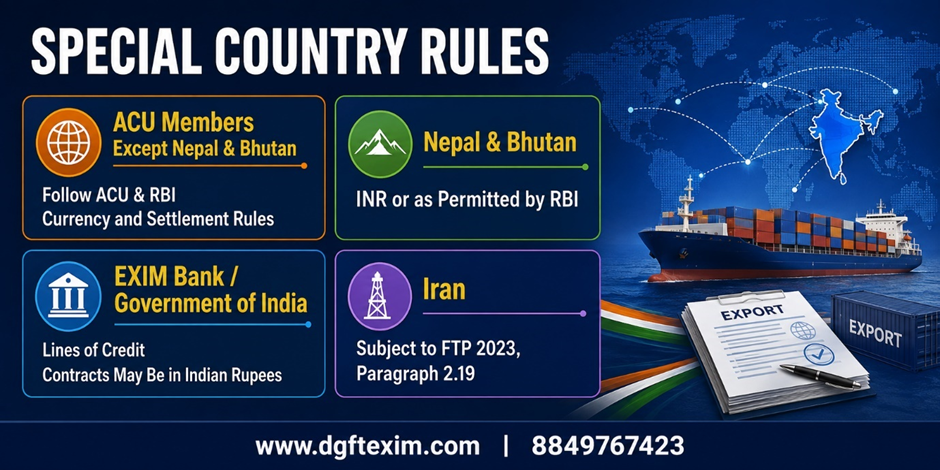
- Exports involving ACU member countries, except Nepal and Bhutan, must follow the currency and settlement rules prescribed by the ACU and RBI.
- Exports to Nepal and Bhutan may be denominated and settled in INR or as permitted by RBI.
- Contracts under EXIM Bank or Government of India Lines of Credit may be denominated in Indian Rupees.
- Exports to Iran remain subject to Paragraph 2.19 of FTP 2023.
· What Should Exporters Check?
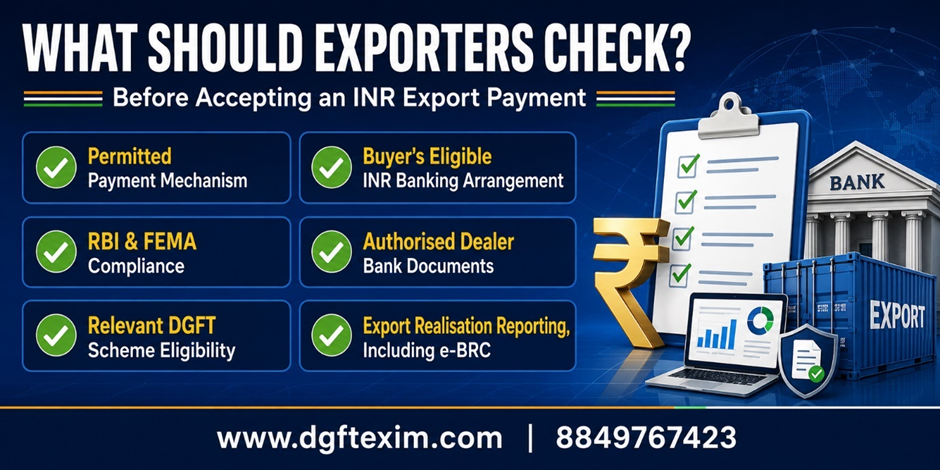
Before accepting an export payment in INR, exporters should confirm:
- The permitted payment mechanism
- The buyer’s eligible INR banking arrangement
- RBI and FEMA compliance
- Documentation required by the Authorised Dealer Bank
- Eligibility under the relevant DGFT scheme
- Proper reporting of export realisation, including e-BRC, wherever applicable
· Conclusion
This DGFT amendment supports the wider use of the Indian Rupee in international trade and may help exporters reduce foreign exchange risk and conversion costs.
However, INR export payments must be received through an authorised banking route. Exporters should consult their bank before finalising the payment terms.
For assistance with DGFT, Advance Authorisation, EPCG and export-import compliance, contact DGFT EXIM Consultants.