
Indian Export Schemes Guide: FTP & Customs Benefits Every Exporter Must Know (AA, EPCG, RoDTEP, MOOWR & More)
Explore key Indian export schemes under the Foreign Trade Policy and Customs framework, including AA, EPCG, RoDTEP, and MOOWR. This guide explains how exporters can reduce costs, claim duty benefits, and stay compliant while improving global competitiveness.
What Are FTP/Customs Schemes?
FTP/Customs Schemes are government initiatives under India’s Foreign Trade Policy designed to support and promote exports. These schemes help businesses reduce or eliminate duties and taxes on inputs used for export production, improve cash flow, and enhance global competitiveness. They broadly include duty exemption, remission, and deferment mechanisms, ensuring exporters can operate efficiently while complying with regulatory requirements.

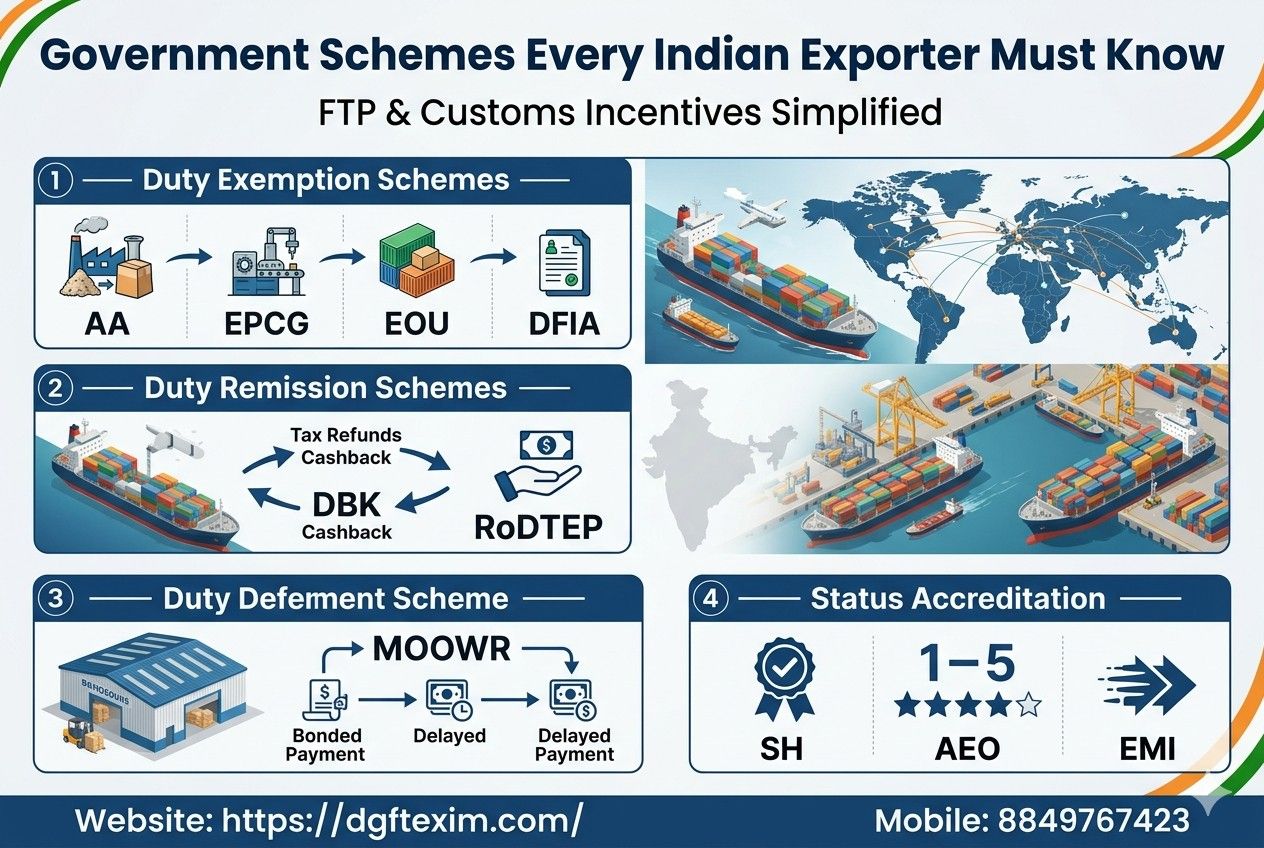
The Government of India, through DGFT and CBIC, administers several incentive and facilitation schemes under the Foreign Trade Policy. These are broadly classified into three categories:

-
Duty Exemption Schemes – Allow import of inputs without paying customs duty.
-
Duty Remission Schemes – Refund or remit duties/taxes already paid on inputs used in exports.
-
Duty Deferment Schemes – Allow deferral of customs duty payment to a later stage.
Duty Exemption Schemes

These schemes allow exporters to import raw materials, inputs, or capital goods without paying customs duty, subject to fulfilment of export obligations. There are four schemes under this category:
-
Advance Authorisation (AA)
Allows duty-free import of inputs physically incorporated in the export product. Issued by DGFT, it is subject to an export obligation that must be fulfilled within the prescribed period. Widely used by manufacturer-exporters across all sectors. -
Export Promotion for Capital Goods (EPCG)
Enables import of capital goods — machinery, equipment, spares — at zero or concessional customs duty for producing quality export goods. The exporter must fulfil an export obligation of 6 times the duty saved within 6 years. -
Export Oriented Unit (EOU)
Units set up exclusively for export purposes can import capital goods and raw materials duty-free. EOUs operate under Customs bonding and must achieve positive Net Foreign Exchange (NFE) earnings over a 5-year period. -
Duty Free Import Authorisation (DFIA)
Similar to Advance Authorisation, DFIA allows duty-free import of inputs after the export obligation is completed. A key advantage is that DFIA is freely transferable after fulfilment of the export obligation, making it commercially attractive.
Duty Remission Schemes

These schemes provide a refund or remission of duties and taxes paid on inputs used in export production. Two major schemes fall under this category:
-
Duty Drawback Scheme (DBK)
Provides refund of duties and taxes on inputs used in the manufacture of exported goods. Inputs need not be imported — even locally purchased inputs are covered, as DBK accounts for embedded central excise, customs duties, and other levies in the supply chain. Available as All Industry Rates (AIR) or Brand Rates, administered by CBIC. -
Remission of Duties and Taxes on Exported Products (RoDTEP)
Introduced to replace MEIS, RoDTEP reimburses embedded central, state, and local duties and taxes not refunded through any other mechanism — such as VAT on fuel, mandi taxes, and electricity duties. Benefits are credited as transferable scrips in the ICEGATE system.
Duty Deferment Scheme

Unlike exemption or remission, this scheme defers the payment of customs duty to a later point in the manufacturing or export cycle, improving working capital efficiency:
-
Manufacturing and Other Operations in Warehouse Regulations (MOOWR)
Allows businesses to carry out manufacturing or processing inside a Customs Bonded Warehouse. Imported goods can be stored and processed without paying customs duty upfront — duty is payable only when goods are cleared for domestic consumption. Exported goods are cleared duty-free. MOOWR is increasingly popular as an alternative to EOU and Advance Authorisation.
Status Accreditation Programmes

Beyond scheme categories, the government recognises high-performing and compliant exporters through status accreditation. These unlock additional benefits and faster processing across trade facilitation mechanisms:
-
Status Holder (SH)
Exporters achieving specified export performance thresholds (in USD) are recognised as One Star to Five Star Export Houses. Status Holders enjoy self-certification privileges, priority processing, and reduced bank guarantees under FTP. -
Authorised Economic Operator (AEO)
A CBIC programme certifying importers, exporters, and logistics service providers as trusted trade partners. AEO-certified entities benefit from faster Customs clearance, reduced examination, deferred duty payment, and recognition in international Mutual Recognition Agreements (MRAs). -
Eligible Manufacturer Importer (EMI)
A new trust-based initiative by CBIC to boost “Ease of Doing Business.” It allows compliant manufacturers to clear imported goods immediately and defer customs duty payments to a monthly cycle. By reducing dwell time at ports and freeing up working capital, the scheme serves as a fast-track bridge for businesses aiming for full AEO status.
Conclusion
