
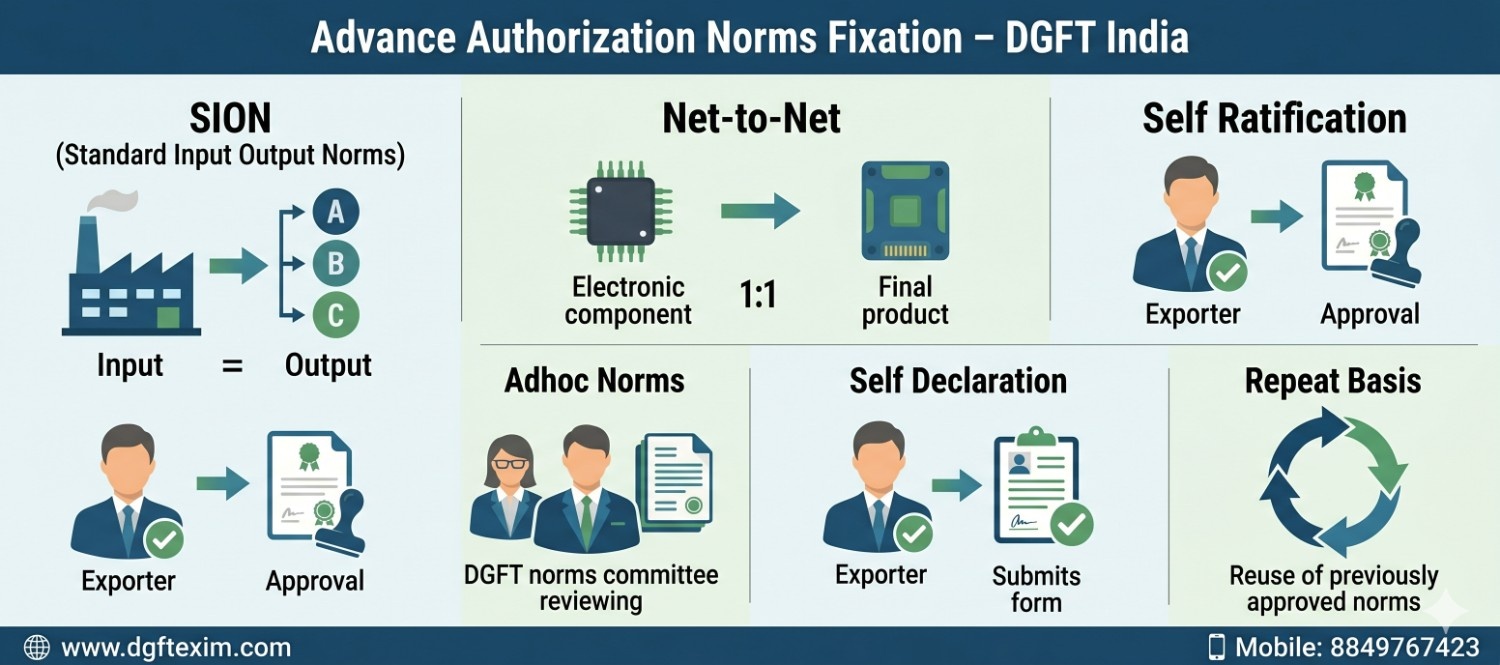
Learn Advance Authorization norms fixation under DGFT India including SION, net-to-net, self ratification & adhoc norms with examples.
Advance Authorization norms fixation in India is governed by DGFT under the Foreign Trade Policy.Norms fixation under Advance Authorization refers to the process of determining input-output ratios for export products as per DGFT guidelines. These norms define how much raw material can be imported duty-free against export obligations.
In India's foreign trade policy, "norms" refer to the standard input-output ratios prescribed for manufactured export products. They determine how much raw material an exporter can import duty-free against a given export obligation. The type of norm applicable to your product defines how your Advance Authorisation is processed, scrutinised, and redeemed at the DGFT.

SION — Standard Input Output Norms

Most Common Route
SION stands for Standard Input Output Norms. These are pre-fixed norms notified by the DGFT (Directorate General of Foreign Trade) for thousands of export products. They specify the exact quantity of inputs — raw materials, components, consumables — required to produce one unit of the export product. SIONs are publicly available in the Handbook of Procedures and are the fastest route to obtaining an Advance Authorisation.
How It Works
The exporter checks the SION schedule for their export product. If a matching SION entry exists, they simply apply for an Advance Authorisation citing that SION. No separate norm fixation is needed. The authorisation is issued based on the pre-fixed norms, and imports are permitted duty-free within those quantities
REAL-WORLD EXAMPLE — Woven Cotton Fabric
Product: Woven Cotton Fabric (Export)
SION for cotton fabric prescribes: 1.05 kg of cotton yarn per 1 kg of fabric exported.
An exporter who ships 10,000 kg of fabric can import 10,500 kg of cotton yarn duty-free under
the Advance Authorisation, based solely on the published SION — no separate approval or
documentation for norm fixation is required.
Component Net to Net

Engineering & Assembly Exports
This norm type applies when the finished export product is assembled from specific components that are incorporated without any substantial transformation — i.e., the imported component goes into the final product in essentially the same form ("net to net"). There is no wastage allowance as the component retains its identity in the exported product. This is common in electronics, machinery parts, and assembly-intensive industries.
How It Works
The norm allows import of the component in the exact quantity as incorporated in the final exported product. Since the component is used net-to-net, the authorisation value for that item mirrors the export quantity one-to-one. Typically used alongside SION for other inputs, or as a standalone norm for pure assembly exports.
REAL-WORLD EXAMPLE — Electronic Control Unit (ECU)
Product: Exported Electronic Control Unit (ECU) for Automobiles
A manufacturer assembles ECUs for automobiles for export. Each ECU contains one imported
microcontroller chip that is directly incorporated without alteration.
Under Component Net to Net, if 5,000 ECUs are exported, the authorisation permits duty-free
import of exactly 5,000 microcontroller chips — no wastage factor, no ratio conversion,
strictly one-to-one.
Self-Ratification

Fast-Track for Star Export Houses
Self-Ratification is a facility introduced to reduce dependence on the norms committee for certain exporters. Eligible exporters — typically those with Two-Star Export House status or above and Authorised Economic Operator with a clean compliance record — can self-certify their own input-output norms without waiting for DGFT's Norms Committee to fix or ratify them. This dramatically cuts down authorisation processing time.
How It Works
The exporter submits a self-certified statement of norms along with their Advance Authorisation application. A Chartered Engineer certifies the reasonableness of the claimed norms. The authorisation is processed on this basis. Post-export, the self-ratified norms are subject to scrutiny by a nominated agency or DGFT to ensure accuracy and prevent misuse.
REAL-WORLD EXAMPLE — Customised Industrial Pump
Product: Customised Industrial Pump (no SION available)
A Two-Star Export House manufactures highly specialised pumps for a German buyer.
No SION exists for this product.
Rather than waiting 3-6 months for norms committee fixation, the exporter self-certifies:
"1.8 kg of stainless steel + 0.4 kg of copper alloy per pump." Their Chartered Engineer
signs off, and the authorisation is issued within weeks — enabling timely export fulfilment.
Prior Fixation of Adhoc Norms

For New or Innovative Products
When an exporter's product does not have a pre-existing SION and the exporter is not eligible for Self Ratification and Self Declaration Scheme, they can approach the DGFT's Norms Committee to get norms fixed before the export takes place. These are called adhoc norms, and this route involves a formal application with technical details of the manufacturing process.
How It Works
The exporter files an application with the Norms Committee detailing the inputs, manufacturing process, and expected output with supporting technical documentation. The Committee examines the application and fixes adhoc norms specifically for that product and exporter. The Advance Authorisation is then issued based on these newly fixed adhoc norms, prior to commencement of exports
REAL-WORLD EXAMPLE — Biodegradable Packaging Material
Product: Newly developed biodegradable packaging material
An Indian startup develops a novel starch-based packaging film with no existing SION.
Before securing a large export contract, they apply to the Norms Committee with their
process flowchart and lab test reports.
The Committee fixes adhoc norms: "2.2 kg corn starch + 0.15 kg plasticiser per kg of
packaging film." The exporter can now plan imports and exports with certainty.
No Norms / Self Declaration

Norms Fixation from DGFT Norms Committee.
Under this category, there is no pre-fixed norm and the exporter declares their own input-output consumption at the time of redemption (after export). The Advance Authorisation is issued on the basis of the exporter's own declaration of norms. This norms needs to be approved by DGFT norms Committee.
How It Works
The exporter declares proposed norms at the application stage. Advance Authorisation gets issued. Meanwhile DGFT Norms Committee Approves the Norms. You apply for Redemption after Import, Export and Norms Fixation.
REAL-WORLD EXAMPLE — Product without SION.
Product: Handcrafted silver jewellery.
A silversmith receives a one-off export order for 200 custom silver pieces.
No SION exists; self-ratification is unavailable to them.
They declare: "12 grams of silver per piece." Norms approves silver consumption as 11.8 grams per piece. Redemption is processed on the basis of Norms approved by Norms Committee.
quantity, and any small excess duty-free import is repaid at applicable customs duty.
No Norms — Repeat Basis

For Items which have Norms already approved under No Norms Self Declaration.
This is an extension of the "No Norms / Self Declaration" route, specifically for exporters who have previously exported the same product and Norms are already approved by Norms Committee and uploaded on DGFT Portal. The exporter can apply on a repeat basis citing previously approved Norms by Norms Committee, simplifying and expediting the authorisation process.
How It Works
The exporter references the norms certified and verified in a prior Advance Authorisation case applied under No Norms Self Declaration by Norms Committee. A new authorisation is issued based on this repeat norm without fresh norm committee scrutiny. However, if the product, process, or specifications change materially, a fresh declaration or norm fixation is required.
REAL-WORLD EXAMPLE — Leather Wallets (Recurring Order)
Product: Customised leather wallets — recurring buyer order
A leather goods exporter previously exported the same wallet design under
"No Norms / Self Declaration" and had their consumption of 0.045 sq.m of leather
per wallet verified and certified by Norms Committee.
They now receive a new order for the same product. They apply under "No Norms - Repeat
Basis," quoting the previously verified norm. The authorisation is issued swiftly without
undergoing a fresh declaration-and-verification cycle.
Conclusion: Choosing the Right Norm Type
The type of norm you select directly impacts how quickly your Advance Authorisation is processed, your compliance obligations at redemption, and your overall trade finance efficiency.
Always start by checking if a SION exists for your product — it is the simplest and fastest route. If not, assess your export house status, product novelty, and export frequency to determine whether Self Ratification, Prior Fixation, or a Declaration-based route is most appropriate.
