
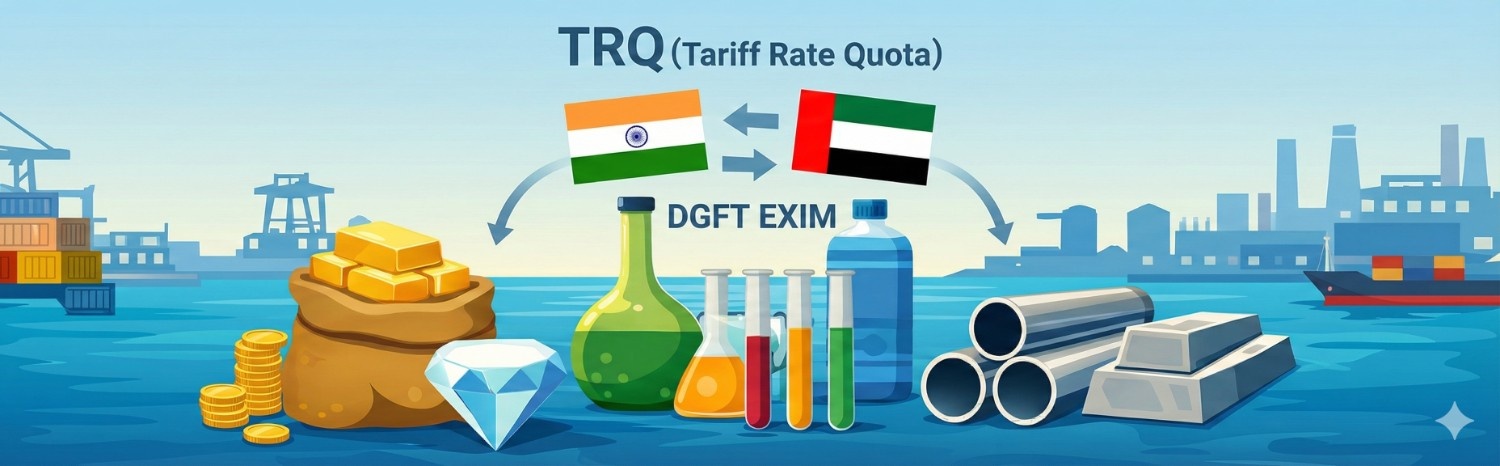
Trq scheme and India fta list 2026
In the competitive landscape of international trade, high customs duties often act as the biggest barrier to profitability. For Indian importers, two powerful government mechanisms exist to legally slash these costs: Tariff Rate Quotas (TRQ) and Free Trade Agreements (FTAs).
TRQ is a quota-based system that allows you to import specific "sensitive" commodities—such as Gold, Corn, or Polymers—at a significantly lower duty rate, up to a fixed quantity limit. Once the quota is full, higher standard duties apply, making timely application crucial.
FTAs, such as the India-UAE CEPA or India-ASEAN pacts, are broader agreements that eliminate or reduce duties on thousands of products, provided you meet the "Rules of Origin" criteria.
TRQ & Free Trade Agreements: Your Gateway to Lower Import Duties
In the competitive world of international trade, a 5% difference in margins can be the deciding factor between a profit and a loss. For Indian importers, two powerful mechanisms exist to reduce customs duties legally: Tariff Rate Quotas (TRQ) and Free Trade Agreements (FTAs).
Many traders confuse the two or fail to utilize them effectively. This guide breaks down exactly what TRQ is and provides an updated list of India's trade agreements as of 2026.
Part 1: What is a Tariff Rate Quota (TRQ)?
TRQ (Tariff Rate Quota) is a mechanism that allows you to import a specific quantity of a product at a lower (concessional) duty rate. Once that quantity limit (quota) is reached, any further imports are charged at the standard (higher) duty rate.
How it Works (The "Two-Tier" System)
Imagine you want to import Corn (Maize).
-
Inside the Quota: The first 500,000 MT might be allowed at 15% Duty.
-
Outside the Quota: Anything imported after that 500,000 MT limit is reached is charged at 50% Duty.
Key TRQ Items in India:
-
Gold: Under the India-UAE CEPA, specific jewelers can import gold at a 1% duty concession (allocated via TRQ).
-
Agriculture: Corn (Maize), Milk Powder, Crude Sunflower Oil, and Refined Rape/Mustard Oil often fall under TRQ to protect domestic farmers while preventing local shortages.
How to Apply for TRQ?
TRQ is not automatic. You must apply for a TRQ License or Authorization from the DGFT.
-
Timeline: DGFT usually opens a specific window (e.g., usually early in the financial year or specific notification dates) for applications.
-
Allocation: It is often allocated on a pro-rata basis or based on past performance/turnover.
Part 2: India’s Free Trade Agreements (FTA) List | Updated 2026 (DGFT Appendix 2A)
While TRQ is specific to certain items, FTAs are broad agreements that offer zero or low duties on thousands of products.
Here is the snapshot of India's key trade pacts that you should be using to save costs:
The "New Era" Pacts (High Impact)
These are modern, deep agreements covering goods, services, and investments.
Agreement |
Partner Countries |
Key Benefits / Status |
India-EFTA (TEPA) |
Switzerland, Norway, Iceland, Liechtenstein |
Huge for machinery, pharma, and Swiss watches. Zero duty on industrial goods. |
India-UAE CEPA |
UAE |
Duty-free access for Gems & Jewelry, Textiles, and Engineering goods. TRQ available for Gold. |
India-Australia ECTA |
Australia |
Zero duty on 96% of Indian exports. Cheaper coal and raw material imports for India. |
India-Mauritius CECPA |
Mauritius |
Active. First trade agreement with an African nation. |
The Asian Giants (Established Pacts)
These are widely used by traders for sourcing electronics, chemicals, and raw materials.
Agreement |
Partner Countries |
Details |
India-ASEAN (AIFTA) |
Singapore, Vietnam, Thailand, Malaysia, Indonesia, etc. |
A massive bloc. Great for electronics, palm oil, and chemicals. |
India-Japan CEPA |
Japan |
Duty-free import of high-tech machinery and industrial raw materials. |
India-Korea CEPA |
South Korea |
Popular for auto components, steel, and electronics. |
India-Singapore CECA |
Singapore |
One of India's oldest and most comprehensive pacts. |
India-Malaysia CECA |
Malaysia |
Specific benefits beyond the ASEAN pact. |
Regional & Other Agreements
-
SAFTA (South Asia): Covers Nepal, Bangladesh, Sri Lanka, Bhutan, Maldives, Pakistan, Afghanistan. (Zero duty on many items from LDC neighbors).
-
ISFTA (India-Sri Lanka): Bilateral pact specifically for trade with Sri Lanka.
-
APTA (Asia Pacific): Includes China, Korea, Bangladesh, Laos, Sri Lanka, Mongolia. (Offers margin of preference, not always zero duty).
-
India-Chile PTA: Preferential Trade Agreement (Limited items).
-
India-Mercosur PTA: Brazil, Argentina, Uruguay, Paraguay. (Crucial for Soybean oil imports).