

Introduction
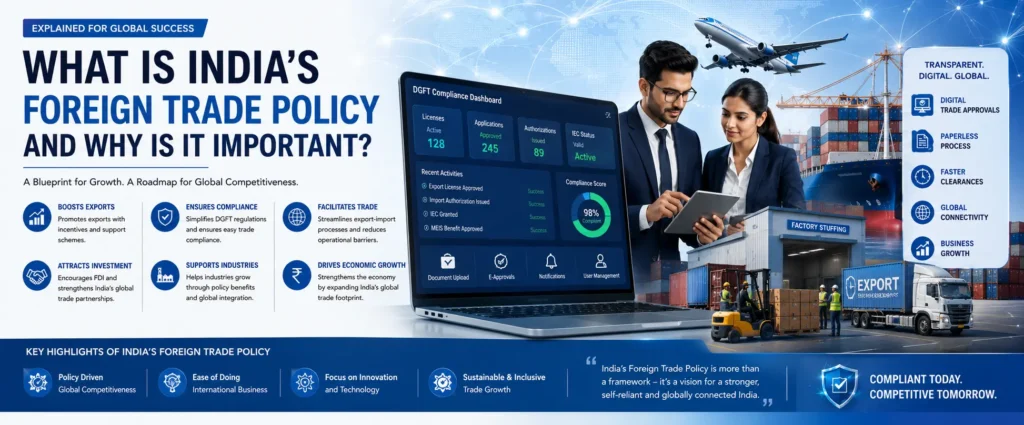
India’s foreign trade policy is a framework of rules and strategies introduced by the Government of India to manage international trade activities. It helps businesses understand the export and import policy in India and provides support for companies dealing in global trade operations. The policy is regulated by the Directorate General of Foreign Trade (DGFT) under the Ministry of Commerce and Industry.
The primary goal of India’s foreign trade policy is to increase exports, regulate imports, and strengthen India’s presence in international markets. It also helps businesses grow globally by offering incentives, simplified procedures, and government-backed support. Many companies take guidance from DGFT consultants to understand trade regulations, licensing, and documentation requirements.
Importance of India’s Foreign Trade Policy
The importance of India’s foreign trade policy lies in its contribution to economic development and international business growth. The export and import policy in India creates opportunities for manufacturers, exporters, traders, and importers to expand their business worldwide.
One of the key objectives of the policy is to encourage exports. When Indian companies sell products internationally, they earn foreign exchange and increase business revenue. This directly supports industries such as textiles, agriculture, pharmaceuticals, electronics, and handicrafts.
The policy also promotes domestic manufacturing under initiatives like “Make in India” and “Atmanirbhar Bharat.” By encouraging local production and exports, the government reduces dependence on imported goods and supports industrial growth.
An important scheme under the policy is Duty-Free Import Authorization. The duty-free import authorization scheme allows exporters to import specific raw materials without paying customs duty if those materials are used for export production. This reduces manufacturing costs and improves global competitiveness for Indian businesses.
Benefits of India’s Foreign Trade Policy
1. Growth in Export Business
The policy helps Indian businesses expand into global markets and increase international sales.
2. Reduced Manufacturing Expenses
Through schemes like duty-free import authorization, exporters can lower production costs by saving on import duties.
3. Job Creation
Export-related industries generate employment in sectors such as manufacturing, logistics, transportation, warehousing, and packaging.
4. Simplified Trade Procedures
The modern export and import policy in India includes digital documentation, online registrations, and faster approvals through DGFT systems.
5. Government Incentives
Businesses receive benefits such as export incentives, tax advantages, and financial support schemes.
6. Better International Competitiveness
The policy encourages Indian businesses to improve product quality and meet international trade standards.
Uses of India’s Foreign Trade Policy
India’s foreign trade policy is widely used by exporters, importers, manufacturers, and trading companies to understand customs regulations, licensing procedures, and trade benefits.
Today, many entrepreneurs search online for an export import company near me to begin or expand their international trade operations. These companies assist with sourcing products, shipping management, customs clearance, and export-import documentation.
Professional DGFT consultants also help businesses with Import Export Code (IEC) registration, export licenses, compliance management, and applications for duty-free import authorization benefits. Their expertise helps businesses complete trade procedures accurately and efficiently.
Industries such as garments, textiles, chemicals, machinery, food products, electronics, and pharmaceuticals regularly use the export and import policy in India for smooth international trade operations.
Cost of India’s Foreign Trade Policy Consultation in Delhi
The cost of India’s foreign trade policy consultation in Delhi depends on the services required and the experience level of the consultant. Basic consultation services for startups and small businesses generally start from ₹2,000 to ₹5,000.
For advanced services such as IEC registration, DGFT licensing, export documentation, customs compliance, and duty-free import authorization applications, professional charges may range between ₹5,000 and ₹25,000 or more.
Experienced DGFT consultants in Delhi may also offer complete import-export business setup packages. These services include registration support, licensing assistance, and guidance related to the export and import policy in India. Choosing an experienced consultant helps businesses avoid delays and maintain smooth trade operations.
Conclusion
In conclusion, India’s foreign trade policy plays a vital role in supporting exports, regulating imports, and strengthening the Indian economy. It offers multiple advantages to businesses through schemes like duty-free import authorization, digital trade processes, and export promotion benefits.
Whether businesses are searching for reliable DGFT consultants or looking for an export import company near me, understanding the export and import policy in India is essential for successful international trade. A strong foreign trade policy not only benefits businesses but also contributes to India’s long-term economic growth and global trade development.